
 简体中文
简体中文 English
 Русский язык
 WhatsApp: +86 15083395008
MAYBE YOU ARE INTERESTED IN
Jinlei MACHINERY knows what you expect from a mining project, and we are making it happen with unrivaled products and services.
Leave Message
Application Areas: Highway Construction and Maintenance: Especially for the construction and routine maintenance of graded highways and rural roads. Municipal Road Engineering: Paving and repair of urban roads. Infrastructure Projects: Airports, ports, etc. Any small to medium-sized projects requiring frequent relocation of the work site.
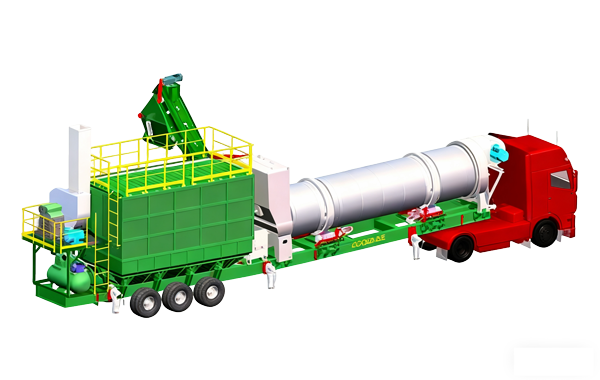
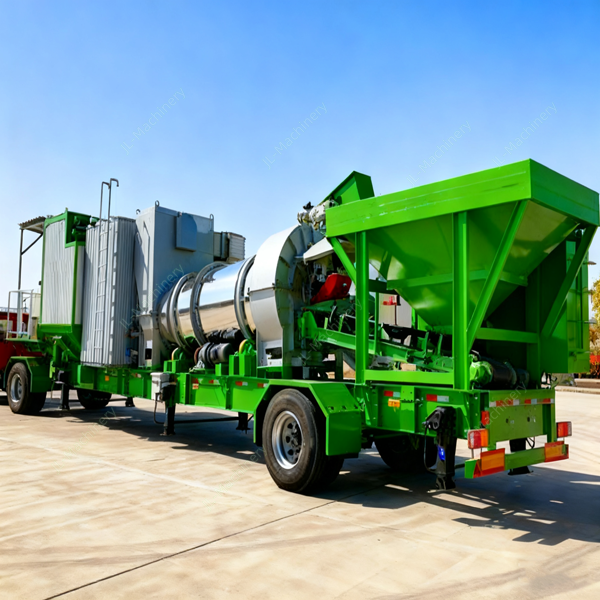
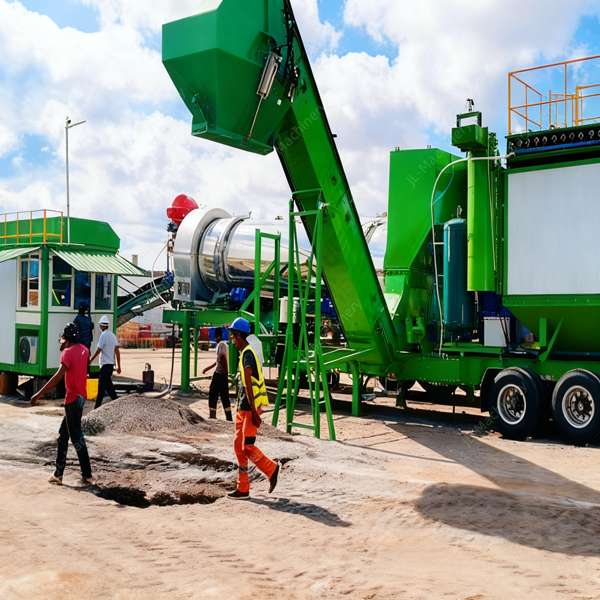
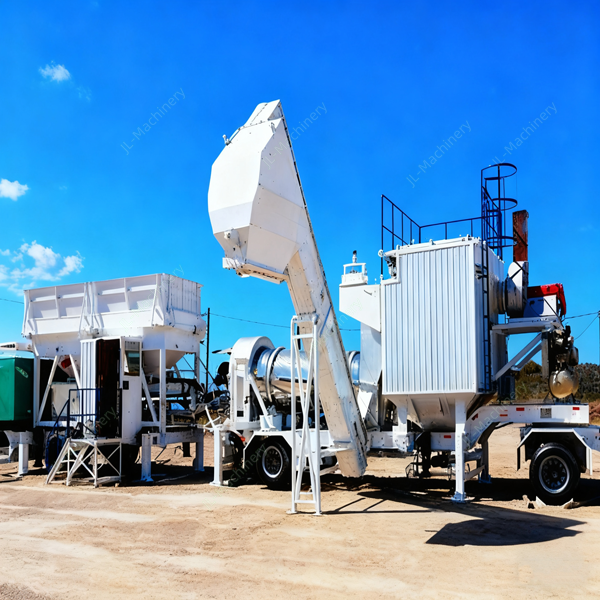
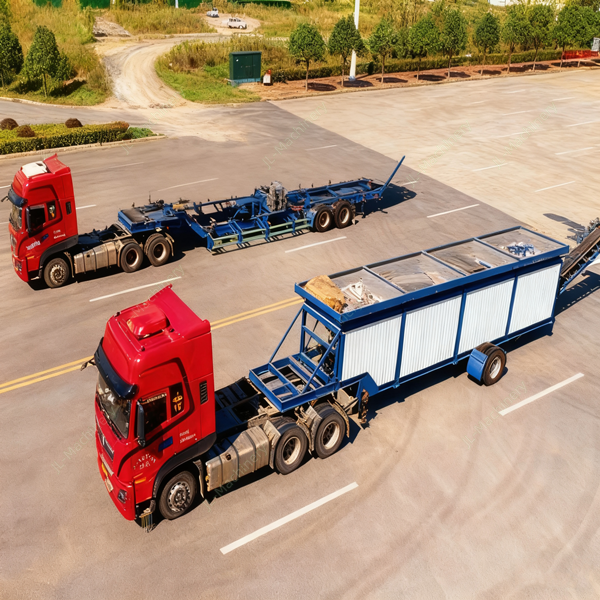
The main structure consists of the following key systems:
Cold Aggregate Supply System:
Components: Cold feed bins, belt feeders, collecting belt conveyor.
Function: Stores aggregates of different specifications such as sand and stone, and conveys them to the drying drum according to the preset proportion.
Drying & Mixing Drum (Core Component):
Structure: A long, inclined drum capable of rotating in both directions, with various types of lifting flights installed inside.
Function: This is the fundamental difference from batch type plants. Aggregates undergo the following processes within this drum:
Drying & Heating: High-temperature hot gas enters the front end of the drum. Aggregates are tumbled and lifted inside the drum, making full contact with the hot gas stream to remove moisture and heat to the set temperature (typically 160-180°C).
Mixing: In the middle and rear sections of the drum, the heated aggregates are mixed with proportionally metered bitumen and mineral filler. Under the continuous rotation of the drum and the action of the flights, they are fully and evenly mixed into a qualified asphalt mixture.
Burning System:
Components: Burner, fuel (oil or gas) supply system, blower fan.
Function: Generates a high-temperature, stable flame and hot gas stream to provide the heat source for the drying drum.
Bitumen Supply System:
Components: Insulated bitumen tank, bitumen pump, metering device.
Function: Heats and maintains the temperature of liquid bitumen, then accurately pumps it into the drying & mixing drum.
Filler Supply System:
Components: Filler silo, screw conveyor, metering device.
Function: Stores and accurately adds mineral filler to improve the performance of the asphalt mixture.
Dust Collection System:
Components: Gravity dust collector, baghouse filter (mainstream), induced draft fan.
Function: Collects dust generated during drying and mixing processes, ensuring emissions meet standards and protecting the environment.
Control System:
Function: Typically uses a PLC (Programmable Logic Controller) and industrial computer to achieve automatic control of the entire production process, recipe management, data recording, and fault diagnosis. Operators can perform all operations from within the control room.
Mobile Chassis:
Function: Integrates all the above systems onto a heavy-duty trailer chassis, equipped with lights and braking systems, complying with road transportation regulations for convenient relocation.
High Mobility and Flexibility:
The core advantage. The modular design and mobile chassis allow the plant to “follow the project from site to site,” making it especially suitable for segmented highway construction, maintenance projects, remote area projects, etc., significantly reducing relocation time and costs.
Compact Structure, Small Footprint:
By integrating multiple functions within a single drum, it eliminates the need for separate large components such as vibrating screens, hot aggregate bins, and mixing units found in batch type plants, resulting in a simpler overall structure and a smaller footprint.
Lower Investment Cost:
The initial purchase cost is generally lower than that of a batch type plant with the same capacity. The simpler structure also means fewer maintenance points and potential failure points.
Relatively Lower Energy Consumption:
With all thermal processes completed within one drum, heat loss is relatively low, resulting in higher thermal efficiency.
High Production Efficiency:
With continuous production, there is no “cycle time” as in batch type plants. As long as the material supply is stable, the plant can continuously discharge finished product.
Feeding: Cold aggregates of different specifications are proportionally taken from the cold feed bins and continuously conveyed by the belt conveyor into the feed end of the drying & mixing drum.
Drying & Heating: Inside the drum, the aggregates tumble forward with the flights, making counterflow contact with the high-temperature hot gas injected from the front end of the drum, where they are quickly dried and heated.
Mixing: As the heated aggregates move to the middle section of the drum, the accurately metered hot bitumen and mineral filler are sprayed in through dedicated pipelines.
Mixing & Discharging: The aggregates, bitumen, and filler continue to be mixed in the rear section of the drum, forming a uniform asphalt mixture, which is finally discharged from the discharge end of the drum directly into trucks or a storage silo.
Dust Collection: Dust and exhaust gases generated throughout the process are drawn by the induced draft fan into the dust collection system, where they are purified before being discharged in compliance with emission standards.
| Parameter | JL-Y20M | JL-Y40M | JL-Y60M | JL-Y80M | JL-Y120M | JL-Y160M | JL-Y200M | Remarks |
|---|---|---|---|---|---|---|---|---|
| Rated Capacity (t/h) | 20 | 40 | 60 | 80 | 120 | 160 | 200 | 5% moisture, standard conditions |
| Fuel Consumption (kg/t) | ≦7 | ≦7 | ≦7 | ≦7 | ≦7 | ≦7 | ≦7 | Light oil / Heavy oil / Gas |
| Total Power (kW) | 50 | 69 | 110 | 150 | 210 | 310 | 390 | Standard configuration |
| Main Unit Dimensions (L×W×H) | 15.5×3.1×4.48 m | 17.9×3.1×4.48 m | 21×3.1×4.48 m | 21×3.1×4.48 m | 21.5×3.1×4.48 m | 22.5×3.1×4.48 m | 23×3.1×4.48 m | |
| Number of Axles | 2 | 2 | 2 | 2 | 3 | 3 | 4 | |
| Cold Feed Bin Volume | 4.5 m³ | 2×4.5 m³ | 3×4.5 m³ | 3×4.5 m³ | 4×4.5 m³ | 4×6.5 m³ | 5×8 m³ | Optional |
| Drum Size (Dia. × Length) | ∅1.2×3.8 m | ∅1.2×5.3 m | ∅1.5×7 m | ∅1.5×8 m | ∅1.8×8.5 m | ∅1.8×8.5 m | ∅2×9 m | |
| Drum Drive Power (kW) | 11 | 15 | 22 | 22 | 7.5×4 | 7.5×5 | 7.5×6 | |
| Dust Collector Type | Baghouse Filter | Other types also optional | ||||||
| Filter Area (m²) | 115 | 150 | 210 | 260 | 340 | 400 | 450 | |
| Induced Draft Fan Power (kW) | 11 | 18.5 | 30 | 30 | 55 | 60 | 65 | |
| Finished Product Silo Volume (m³) | 1 | 1 | 1.5 | 1.5 | 2 | 2 | 2 | |
| Operation Mode | Manual / Automatic | |||||||
| Mixing Type | Drum Continuous Type | |||||||
| Bitumen Heating Method | Electric heating, Thermal oil heating, Direct heating | Optional | ||||||
| Bitumen Metering Method | Flow Metering | |||||||
| Finished Product Temperature (°C) | 130℃~160℃ | |||||||
| Feature | Mobile Drum (Continuous) | Batch (Forced) |
|---|---|---|
| Operating Principle | Drying, heating and mixing continuously in a single drum. | After drying and heating, screening and storing, then precise weighing per batch and forced mixing. |
| Mobility | High, modular mobile design. | Low, mostly stationary or semi-stationary, complex relocation. |
| Batching Accuracy | Relatively lower, sensitive to material fluctuations. | Extremely high, each batch independently metered with precise control. |
| Recipe Change | Inflexible, produces transition material. | Very flexible, suitable for multi-recipe, small-batch production. |
| Equipment Cost | Lower. | Higher. |
| Environmental Friendliness | Modern units perform well; older types are less effective. | Easy to collect and treat dust and asphalt fumes; good environmental performance. |
| Application Scenarios | Small to medium projects with high mobility requirements. | Large, stationary plants; high-grade road construction. |